 |
 |
 |
|
Unfinished Whamdiddle English Boxwood Bones
Fun do-it-yourself project - just sand and rattle away!
Only Half the Price of Finished Bones
These unfinished bones are manufactured from English Boxwood hardwood by Rick Fogel, a master luthier with a graduate degree in Physics. His finished English Boxwood bones sell for $39.97. So finish them yourself and save eight bucks.
Finishing Instructions
-
Sand with medium sandpaper (100 grit).
-
Sand with fine sandpaper (150 grit).
-
Sand with very-fine sandpaper (220 grit). (Rick scrapes them smooth in step 3 with a very sharp hunting knife instead).
Your bones are now ready to play. If you want a durable protective finish, then follow additional steps below.
-
Rub with commercial woodworking oil or paste wax such as Minwax, carnauba wax, beeswax, shellac, butcherblock oil, or other vegetable-based wood preparation. Follow manufacturer's directions or ask your local woodworking store for advice. Rick rubs Whamdiddle bones with marine spar varnish, lets them dry, and calls them done.
-
If desired, buff for high gloss finish. Use soft rag or buffing wheel with tripoli polishing compound.
Look what you get:
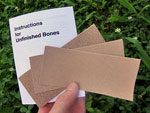
- One pair of unfinished Whamdiddle bones
- Three 2" x 5" sheets of sandpaper (medium, fine and very-fine).
- Simple finishing instructions
Finishing wax, oil, varnish or other surface preparations not included.
English Boxwood is a hard, close-grained and heavy exotic evergreen native to England and Turkey that delivers a strong sharp tone.
This intriguing wood comes from a shrub that usually stands no higher than 3 feet at maturity and can take a century to reach a trunk diameter of 3 inches. Despite its small size, Boxwood produces extremely dense wood that is so heavy it barely floats.
Boxwood is a knotty wood noted for a creamy yellowish tan heartwood that is indistinguishable from the sapwood. The timber is a pale yellow when freshly cut, then slowly changes to a warm brownish yellow with exposure. The unusual wood exhibits a very fine uniform texture featuring a rich and satiny luster.
English Boxwood is a favorite among woodcarvers because it takes fine detail. Boxwood was widely used in 15th century Europe for engraving and printing. "English Boxwood is the king of carving stock, but rare and expensive," says one woodcarving enthusiast. "English Boxwood is...just a joy to use," says another, adding, "Boxwood is still the very nicest material I've used. Ivory comes in second."
Figures below are approximate (but pretty darn close)
Tonality
Whamdiddle Collection
Figures are approximate (but pretty darn close)--
- Length: 8"
- Width: 1" to 1-1/4"
- Thickness: 1/4" to 3/8"
- Composition: Domestic English Boxwood hardwood
- Camber (arc): 28 degrees
- Weight: 2.9 oz
- Color: Pale Yellowish Beige (Creamed English Tea)
- Specific Gravity: .91 (Stronger Tone)
- Density: 57 pcf (Medium Tone)
- Hardness: 2730 Janka (Sharper Tone)
- Sandpaper: Medium (100), Fine (150) and Very-fine (220)
Handcrafted By a Master Luthier with a Graduate Degree in Physics
Whamdiddle bones are magnificent instruments. They are handcrafted from domestic and exotic hardwoods by Rick Fogel. Rick is a master luthier in Seattle, Washington who holds a master of science degree in Physics. This winning combination of top-grade material, brilliant artistry, and scientific expertise explains why Whamdiddle sound as good as they look.
Great Looks, Solid Design, Superior Tone
Take a close look at the marvelous color and fascinating wood grain of Whamdiddle bones. That gorgeous appearance comes from quartersawn wood, so the look is no accident.
The designs are special too. For example, the Whamdiddle Classic Style is less oval than minstrel style bones, yet rounder than flat style bones. This unique design bridges the gap between minstrel and flat styles. You can expect the Classic Style shape to fit especially comfortable in your hands. After all, the design has stood the test of time for more than 40 years. But the first thing you notice when you grab a pair is their substantial heft. Even the lightweight Classic Style bones feel full in your grip.
On the other side of the spectrum are Whamdiddle Flat Style bones. Not only are they agile and thin, but they fit any size hand and deliver a remarkably dynamic range of tones.
Whamdiddle Minstrel Style bones are a blast from the past—perfect for living-history musicians who demand authentic reproduction instruments.
But no matter what style you choose, Whamdiddle bones deliver a rich full range of tones that make you proud to rattle them.
Crafted From Quartersawn Lumber, the Prime Working Stock for Quality Musical Instruments
Why do Whamdiddle bones reveal spectacular grain patterns, warp less, and generate better tone? "Because," Rick explains, "they are made from quartersawn lumber."
Rick described the technique to me but it is a bit complex. So I looked up the term in a technical report from the U.S. Forest Service. They indeed confirm that quartersawn lumber
"shrinks and swells less...splits less...and figure patterns and wavy grain are brought out more conspicuously." Another expert source reports that quartersawn wood "helps prevent warping and also provides the best vibration patterns acoustically." And yet another authority tells us "quartersawn wood helps ensure that an instrument's sound remains as invariable as possible."
So yes, musical bones made from quartersawn lumber are decidedly prime quality instruments. But the ultimate test, of course, is to try them yourself.
Largest Selection of Whamdiddle Bones on the Planet...plus those Famous Laminated Bones.
Welcome to the largest selection of Whamdiddle bones on Earth! No other store offers you a larger choice of Whamdiddle bones. In fact, most of the Whamdiddle bones we offer are designed exclusively for Bone Dry Music and available no place else in the universe.
Please note that each carefully matched pair is expertly hand-crafted, but no two pairs are exactly alike. (i.e. Some pairs might vary slightly from another in length, width and thickness.)
Where does Rick find the exotic, rare, and domestic species of wood for these gorgeous bones? "It's scrap wood left over from the dulcimers I make," he says. So if you see something you really like, get it now. Because when a species of Whamdiddle bones get sold out, they might be gone forever.
Can't Decide Which Bones to Choose?
Check out this handy guide: Bone FAQs
|
|
|
 |
|
 |
|
|
|
 |
|
 |
|
Features
- Solid English Boxwood Hardwood: Excellent for musical bones.
- Proven Shape: Designed by master luthier.
- Quarter-sawn Lumber: Creates stable tone, won't warp or crack.
- Includes Playing Instructions: Shows how to hold and play bones.
- Unfinished Pre-cut, Rough Sanded Hardwood: Fun & easy do-it-yourself project.
- Includes Sandpaper: Saves you a trip to the hardware store.
|
|
|
|
|
|
|