View CartMy Account / Order StatusHelp


New!
It's FREE. It's automatic. You've already got it.

MyRewards
...get cash back!

How to cash-in...


Get Discount and FREE email Newsletter


Credit Card Processing


(Your shopping cart is empty)
You are here: Home > Signature Collection > Adam Klein
We found 8 results matching your criteria.
Adam Klein Bones
Perfect for Big or Small Hands
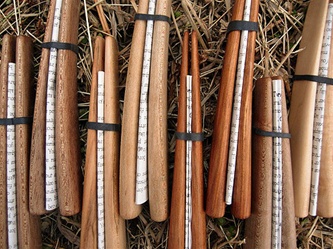
Fine tapered works of art. Smoothest bones you ever laid your hands on.

Can't Decide Which Bones to Choose?
Check out this handy guide: Bone FAQs
Sort By
1
Adam Klein Futon Bones Adam Klein Futon Klakkers Adam Klein Maple Bones Adam Klein Small Maple Bones
Adam Klein Futon Bones
Only $19.97 pair (Out of Stock)
Adam Klein Futon Klakkers
Only $19.97 pair (Out of Stock)
Adam Klein Maple Bones
Only $19.97 pair (Out of Stock)
Adam Klein Maple Bones, small
Only $19.97 pair (Out of Stock)
Reclaimed Wood from Old Futon Frame conserves natural resources.

If you want to rattle bones that save trees and preserve the environment, then this pair might be for you.

Handcrafted Bones from Recycled Furniture
The wood from this pair of bones was reclaimed from the frame of an old futon. Not sure about the species of wood. I compared these bones with my collection of 50 Constantine Cabinet Wood samples but did not find a close match. The color and grain resembles the specimen of East Indian Laurel, but I doubt if they are the same wood. Futons are often made from exotic trees. So even if I cannot make a positive identification, the timber from these bones probably originated in some far away land. In any event, the bones are a little lighter in weight than Norway Maple, and deliver a slightly brighter tone.

Order a pair today and do your part to conserve natural resources!

Reclaimed Wood from Old Futon Frame conserves natural resources.

If you want to rattle bones that save trees and preserve the environment, then this pair might be for you.

Handcrafted Bones from Recycled Furniture
The wood from this pair of bones was reclaimed from the frame of an old futon. Not sure about the species of wood. I compared these bones with my collection of 50 Constantine Cabinet Wood samples but did not find a close match. The color and grain resembles the specimen of East Indian Laurel, but I doubt if they are the same wood. Futons are often made from exotic trees. So even if I cannot make a positive identification, the timber from these bones probably originated in some far away land. In any event, the bones are a little lighter in weight than Norway Maple, and deliver a slightly brighter tone.

What are Klakkers?
Klakkers are just like other Adam Klein bones except they are straight, not curved. They resemble the shape of a bell clapper. Adam says the design was "Inspired by [Rhythm Bones Society member] Parker Waite's aluminum bones which surprised me with their good sound despite not being curved."

Order a pair today and do your part to conserve natural resources!
Norway Maple is excellent for music. Rattling them protects the environment!

These are no ordinary maple bones.

The wood is Norway Maple (acer platanoides). "Norway maple is a common tree throughout much of Europe, including (not surprisingly) Norway," reports the Thompson School of Applied Science at The University of New Hampshire. The school also says "the density of the wood makes it an excellent material for musical instrument soundboards. In fact, the fiddlebacks of the famous and unrivaled Stradivarius violins built by Antonio Stradivarius (1644-1737) are rumored to be made of Norway Maple."

This tree might be common in Europe, but here in the States it is considered an invasive species. So the more bones you buy, then the fewer Norway Maple trees will be left to invade our fair slopes.

Like many bone players, Adam's favorite wood is maple. He prefers this wood because "maple is best for anything," he declares. The wood is "very hard, medium weight, and offers a low risk for splitting," he explains. And Adam is especially fond of those "cool curly sheens."

Order a pair today and do your part to protect the environment!
Norway Maple is excellent for music. Rattling them protects the environment!

These are no ordinary maple bones.

The wood is Norway Maple (acer platanoides). "Norway maple is a common tree throughout much of Europe, including (not surprisingly) Norway," reports the Thompson School of Applied Science at The University of New Hampshire. The school also says "the density of the wood makes it an excellent material for musical instrument soundboards. In fact, the fiddlebacks of the famous and unrivaled Stradivarius violins built by Antonio Stradivarius (1644-1737) are rumored to be made of Norway Maple."

This tree might be common in Europe, but here in the States it is considered an invasive species. So the more bones you buy, then the fewer Norway Maple trees will be left to invade our fair slopes.

Like many bone players, Adam's favorite wood is maple. He prefers this wood because "maple is best for anything," he declares. The wood is "very hard, medium weight, and offers a low risk for splitting," he explains. And Adam is especially fond of those "cool curly sheens."

Designed for Kids
These bones are specially designed for children (or folks with very small hands). Adam has taught hundreds of people how to play the bones and he particularly enjoys teaching school kids. "Bones are an excellent inroad into the world of musical performance," says Adam, "and a good way to get kids to learn about rhythm because they are so cool." Kid-size bones are extremely rare. And now you can get kid-size bones that meet the same demanding quality standards as Adam's full-size bones - at just a smaller scale!


Order a pair today and do your part to protect the environment!
Adam Klein Maple Klakkers Adam Klein Small Maple Klakkers Adam Klein Rosewood Bones Adam Klein Rosewood Klakkers
Adam Klein Maple Klakkers
Only $19.97 pair (Out of Stock)
Adam Klein Maple Klakkers, small
Only $19.97 pair (Out of Stock)
Adam Klein Rosewood Bones
Only $29.97 pair (Out of Stock)
Adam Klein Rosewood Klakkers
Only $29.97 pair 2 in stock!
Norway Maple is excellent for music. Rattling them protects the environment!

These are no ordinary maple Klakkers.

The wood is Norway Maple (acer platanoides). "Norway maple is a common tree throughout much of Europe, including (not surprisingly) Norway," reports the Thompson School of Applied Science at The University of New Hampshire. The school also says "the density of the wood makes it an excellent material for musical instrument soundboards. In fact, the fiddlebacks of the famous and unrivaled Stradivarius violins built by Antonio Stradivarius (1644-1737) are rumored to be made of Norway Maple."

This tree might be common in Europe, but here in the States it is considered an invasive species. So the more bones you buy, then the fewer Norway Maple trees will be left to invade our fair slopes.

Like many bone players, Adam's favorite wood is maple. He prefers this wood because "maple is best for anything," he declares. The wood is "very hard, medium weight, and offers a low risk for splitting," he explains. And Adam is especially fond of those "cool curly sheens."

What are Klakkers?
Klakkers are just like other Adam Klein bones except they are straight, not curved. They resemble the shape of a bell clapper. Adam says the design was "Inspired by [Rhythm Bones Society member] Parker Waite's aluminum bones which surprised me with their good sound despite not being curved."


Order a pair today and do your part to protect the environment!

Norway Maple is excellent for music. Rattling them protects the environment!

These are no ordinary maple Klakkers.

The wood is Norway Maple (acer platanoides). "Norway maple is a common tree throughout much of Europe, including (not surprisingly) Norway," reports the Thompson School of Applied Science at The University of New Hampshire. The school also says "the density of the wood makes it an excellent material for musical instrument soundboards. In fact, the fiddlebacks of the famous and unrivaled Stradivarius violins built by Antonio Stradivarius (1644-1737) are rumored to be made of Norway Maple."

This tree might be common in Europe, but here in the States it is considered an invasive species. So the more bones you buy, then the fewer Norway Maple trees will be left to invade our fair slopes.

Like many bone players, Adam's favorite wood is maple. He prefers this wood because "maple is best for anything," he declares. The wood is "very hard, medium weight, and offers a low risk for splitting," he explains. And Adam is especially fond of those "cool curly sheens."

What are Klakkers?

Klakkers are just like other Adam Klein bones except they are straight, not curved. They resemble the shape of a bell clapper. Adam says the design was "Inspired by [Rhythm Bones Society member] Parker Waite's aluminum bones which surprised me with their good sound despite not being curved."

Designed for Kids

These bones are specially designed for children (or folks with very small hands). Adam has taught hundreds of people how to play the bones and he particularly enjoys teaching school kids. "Bones are an excellent inroad into the world of musical performance," says Adam, "and a good way to get kids to learn about rhythm because they are so cool." Kid-size bones are extremely rare. And now you can get kid-size bones that meet the same demanding quality standards as Adam's full-size bones - at just a smaller scale!

Order a pair today and do your part to protect the environment!

Recycled Rosewood conserves natural resources.

If you want to rattle bones that save trees and preserve the environment, then this pair might be for you.

Handcrafted from Recycled Timber
The wood from this pair of bones was reclaimed from, uh...well, I am not exactly sure. But Adam is something of an environmental zealot. He does not buy exotic wood "unless it's scrap that otherwise would have been thrown out or burned." So you can bet your bippy that he tracked down this wood from an environmentally correct source.

Order a pair today and do your part to conserve natural resources!

Recycled Rosewood conserves natural resources.

If you want to rattle bones that save trees and preserve the environment, then this pair might be for you.

Handcrafted from Recycled Timber
The wood from this pair of bones was reclaimed from, uh...well, I am not exactly sure. But Adam is something of an environmental zealot. He does not buy exotic wood "unless it's scrap that otherwise would have been thrown out or burned." So you can bet your bippie he tracked down this wood from an environmentally correct source.

What are Klakkers?
Klakkers are just like other Adam Klein bones except they are straight, not curved. They resemble the shape of a bell clapper. Adam says the design was "Inspired by [Rhythm Bones Society member] Parker Waite's aluminum bones which surprised me with their good sound despite not being curved."

Order a pair today and do your part to conserve natural resources!
   
 
1
Hand Sculptured Environmentally Green Musical Instruments

Adam Klein Bones are a combination of fine art, environmental consciousness and functional musical instrument design. These bones are sculpted by an artist who enjoys making musical bones in various shapes and sizes. The wood for his instruments comes from reclaimed, organically grown or sustainably managed timber. The curved tapered bones "have been my standard shape since about 2002," he says. Another factor that sets Adam's hand sculptured musical bones apart from the rest is the care he takes in cutting the wood blank. "I try to get the grain to run parallel to the shape," he reveals.

Tapered Design is Great for Big or Small Hands
What are tapered bones? Tapered bones are easy to recognize because one end is thinner than the other. Most folks like putting the thin end between their fingers because it's more comfortable that way. But there ain't nothing wrong with playing them with the thick ends between your fingers. Or if you are like me, you might just play them every-which-way.

Hand Signed Bones with a Secret Code
Each bone is signed by hand in a way that lets you know which bone is which - if you know the secret!

Mozart was fond of writing backwards. So is Adam Klein. Observant customers will notice the written label at the end of one pair of Adam Klein bones is written from left to right. The other bone's label is written from right to left. In other words, the writing on one bone is normal - the other is backwards.

Yes...this might seem a little odd. But after all, Adam is an opera singer by trade, and thus a tad eccentric (as is my mezzo-soprano sister-in-law). However, the left & right writing does serve a practical purpose. Because if you want to know which bone is which - all you have to do is look at the ends.

Easy to Keep these Bones in their Place
If it matters to you which bone is which, then "you can distinguish them more easily by the different direction of the signatures," says Adam. Here is my recommendation if you want to know which bone is which: Just keep the backward bone closest to your thumb (this is the "anvil" or stationary bone). That way you can read at least one of the bones. Otherwise, if the anvil bone is the normal bone, then you cannot read either bone because the text on one is backward and the other is upside down.

Does all this sound confusing? Yes, it does. So some players will notch the bones instead. And other players won't care which bone is which. But in any event, you will own a pair of uniquely hand signed bones with a special secret code.

What possessed Adam to label one bone backwards?
Here's the story:
"The right-to-left signature on one of each pair stems from my being a lefty," explains Adam. "And several years ago," he continues, "I started signing opera posters for donors and such right to left, just to make them think." Well, everyone knows that bone players are extremely intelligent beings. So Adam decided to do the same thing with the bones. And here we are.

Elegant Design and Finish
The design is quite elegant. And the extra fine finish gives your instruments the deepest most opalescent finish I have ever seen on wooden bones.

Smoothest Bones You Ever Laid Your Hands On
Other bone makers, like myself, sand musical bones to a nice smooth 120 grit finish and call them done. With Adam, however, 120 grit is barely getting started. You would think he might quit when the bones are more than twice as smooth - say, 320 grit? No, Adam does not stop there. He continues to sand them finer. If you were a fly on the wall you would see Adam sanding past 400 grit...then 600 grit...even 800 grit and beyond. In fact, when Adam reaches 1,000 grit (yes, I said one-thousand grit), he is still only half-way done. I know you will find this hard to believe, but your Adam Klein bones are hand sanded to an astonishingly silky smooth 2,000 grit finish.

Are they done now?
No. After sanding the bones, Adam meticulously signs, dates and labels each one by hand using India ink, fills the ends as needed with crystal clear epoxy resin, then carefully hand rubs the entire surface of each instrument with boiled linseed oil (a natural product made from flax seed). Now they are done.

adam klein Who is Adam Klein?
Adam Klein is an eclectic and environmentally conscious person who sings opera, plays and makes banjos, dulcimers and various other stringed things. He also crafts wind instruments, drums, and of course, rhythm bones. "I use recycled and rescued material whenever possible," says the habitatually responsible luthier.

Adam also teaches photography, carpentry, woodcrafting, "raw" food and other culinary curiosities including how to make tofu actually taste like something.

He has composed two operas: Leithian, based on The Silmarillion by J.R.R. Tolkien; And a children's opera, Goldie Locks And The Three Bears, featuring acoustic tunes and traditional songs.

Adam speaks (or sings) several dialects of English and is familiar with French, Italian, German, Russian and some Czech. He is acquiring a working knowledge of Brazilian Portuguese, Tuvan and Japanese and hopes to add Mandinka to the list.


He has taught hundreds of people how to play the bones and especially enjoys teaching school children. "Bones are an excellent inroad into the world of musical performance," says Adam, "and a good way to get kids to learn about rhythm because they are so cool."
Bone Dry Musical Instrument Co.
3916 Iowa Ave.
Saint Louis, MO 63118-4514
Contact
 About Us
 Become an Affiliate
 Privacy Policy
 Send Us Feedback